Risk Management
The math that keeps you in the game: R:R, break-even discipline, scaling in without adding risk, and what a losing streak really looks like.
Risk to Reward (R:R)
Risk-to-Reward (R:R) is the ratio between how much you are willing to lose on a trade and how much you expect to gain.
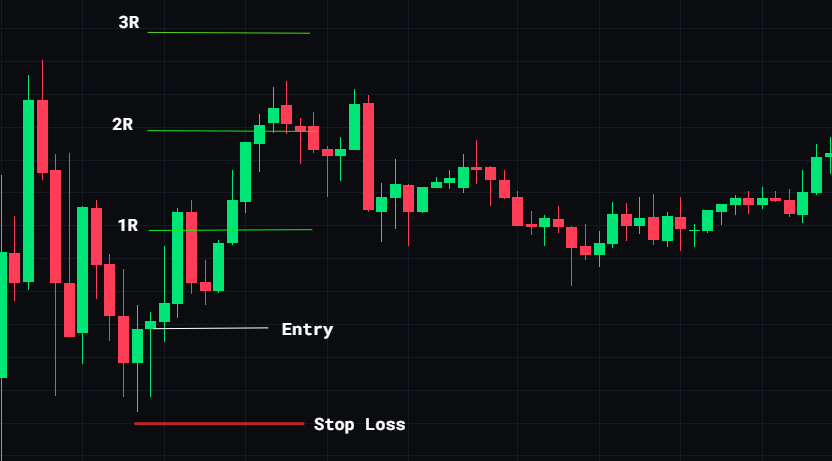
- Risk = distance from entry to stop loss
- Reward = distance from entry to take profit
Minimizing Trade Time
Minimizing trade time — reducing the time you spend in a trade improves your RR and reduces emotional exposure.
Moving to Break Even
Moving to Break Even (BE) means adjusting your stop loss to your entry price after the trade moves in your favor — also called a "risk-free trade."
Should you do it? And if yes, when? Some traders suggest moving to BE at a specific RR level. The recommended approach is to move it based on market structure — not a fixed number.
Adding Up to a Position
Adding up to a position is used to minimize trade time or increase your R:R while keeping your total risk the same.
Consecutive Losses
Consecutive losses happen in every strategy no matter what you do. The table below shows how many consecutive losses to expect based on your win rate.
| WIN RATE | 3 IN A ROW | 5 IN A ROW | 7 IN A ROW |
|---|---|---|---|
| 30% | 35% | 17% | 8% |
| 40% | 22% | 8% | 3% |
| 50% | 13% | 3% | 0.8% |
| 60% | 6% | 1% | 0.2% |
| 70% | 3% | 0.2% | <0.1% |
Your win rate is mostly tied to your R:R. Lower R:R = higher win rate. Higher R:R = more consecutive losses expected.
Test yourself — 5 questions
Pick an answer to see instantly whether it is right. Nothing is saved to a server and no account is needed.
-
01What is a 1:2 Risk-to-Reward (R:R) ratio?
-
02Why is 1:2 R:R considered the sweet spot in this course?
-
03What does "minimizing trade time" primarily help with?
-
04When should you consider moving your SL to break even?
-
05At a 50% win rate, what is the approximate probability of getting 5 consecutive losses?
Now test it on real historical charts
Reading is step one. Replay real historical data bar by bar, place the trades this module describes, and see whether the idea actually holds up before you risk money on it.
Start backtesting freeFree plan — no card required.