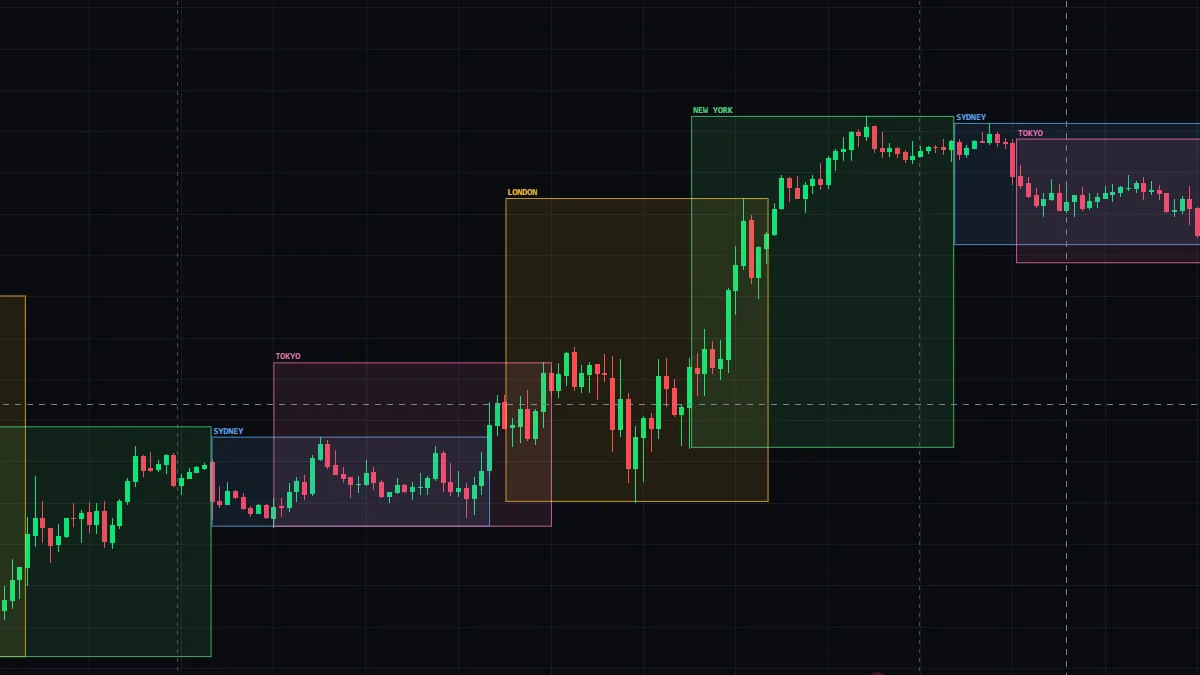
The 24-hour forex market is not one market
Retail traders are often told that forex is open 24 hours a day, five days a week. That is technically true. The deeper truth is that the 24-hour window is made up of several overlapping sessions, each driven by different financial centers, different institutional participants, and different economic calendars.
Trading EUR/USD at 3 AM UTC is a different experience than trading it at 9 AM UTC, even though the pair and the chart look the same. Volume is lower, spreads are often wider, and price tends to drift or chop rather than move with conviction. The session your strategy runs in is not a minor detail — it is a core part of the strategy's context.
All four session hours in UTC, EST and GMT
Most confusion about session hours comes from quoting them in a local time that moves twice a year. The table below gives each session in UTC, which never shifts, alongside the two local clocks traders most often convert to. Summer rows use northern-hemisphere daylight saving (BST and EDT); winter rows use standard time.
| Session | UTC (summer) | UTC (winter) | EST/EDT (New York) | GMT/BST (London) |
|---|---|---|---|---|
| Sydney | 21:00–06:00 | 22:00–07:00 | 17:00–02:00 | 22:00–07:00 |
| Tokyo | 00:00–09:00 | 00:00–09:00 | 20:00–05:00 | 00:00–09:00 |
| London | 07:00–16:00 | 08:00–17:00 | 03:00–12:00 | 08:00–17:00 |
| New York | 13:00–22:00 | 14:00–23:00 | 08:00–17:00 | 13:00–22:00 |
Japan does not observe daylight saving, so the Tokyo session is the one fixed point in the schedule — it sits at 00:00–09:00 UTC all year. Every other session moves by an hour relative to UTC when its own country changes clocks, and because the US and UK change on different dates, there are two short windows each year when the London–New York overlap is an hour longer or shorter than usual.
Sydney session — 21:00 to 06:00 UTC
Sydney opens the trading week and the trading day. It is the thinnest of the four sessions by volume, and for most pairs it produces the widest spreads of the 24-hour cycle. AUD and NZD pairs see their first genuine participation here, and AUD/JPY and AUD/USD are the two instruments where Sydney hours are worth testing on their own rather than treating as dead time.
For everything else, Sydney's practical role is that it sets the first reference levels of the day. If your strategy uses an overnight high and low, Sydney is usually where that range starts forming.
Tokyo session (the Asian session) — 00:00 to 09:00 UTC
When traders say "the Asian session" they almost always mean this window. Strictly there are four sessions and Sydney is its own, but Sydney and Tokyo overlap for several hours and are usually treated as one Asian block — which is why you will see the forex day described as three sessions in some places and four in others. Both are describing the same 24 hours.
Tokyo is the volume centre of Asian hours and overlaps Sydney for its first several hours. Price often ranges inside tighter boundaries here than in London or New York, which is why range and mean-reversion rules tend to test better in this window than breakout rules do.
Tokyo session behavior depends heavily on what pairs you are watching. JPY pairs — USD/JPY, GBP/JPY, EUR/JPY, AUD/JPY — are most active here because Japan is the dominant financial center. AUD and NZD pairs also see genuine participation during this window.
For strategies that trade London or New York setups, Tokyo often builds the range or liquidity pool that the later session breaks. Identifying the Asian high and low before London opens is a common preparatory step for many price action traders.
London session — 07:00 to 16:00 UTC
The London session is the single largest forex session by trading volume. It opens at 07:00 UTC during British Summer Time and 08:00 UTC in winter, when London is on GMT, and it brings major banks, institutional desks, and hedge funds into the market simultaneously. The result is a consistent and often sharp increase in volatility within the first one to two hours of the open.
EUR/USD, GBP/USD, EUR/GBP, GBP/JPY, and USD/CHF are the dominant pairs during London hours. These pairs tend to trend with conviction during the first push, which is why many trend-following and liquidity-grab strategies target the London open specifically.
Spreads tighten considerably during London hours compared to the Asian session. For strategies that depend on accurate pip measurements — such as fixed-target systems — London hours give the cleanest execution environment in most brokers.
New York session — 13:00 to 22:00 UTC
The New York session opens at 13:00 UTC and runs through the late afternoon. It adds significant volume because US economic data — NFP, CPI, FOMC decisions, GDP releases — tends to be released in the first two hours. These releases create some of the sharpest and fastest moves in the market calendar.
USD pairs dominate during the New York session: EUR/USD, GBP/USD, USD/CAD, USD/JPY. After the major news window closes, New York mid-session (roughly 16:00–20:00 UTC) can slow considerably. The final two hours of the New York session — as it approaches close — often see reduced liquidity and less reliable price behavior.
Many traders avoid the final hour of New York entirely, treating it as a low-confidence window. If your backtesting data shows a cluster of losses in the 21:00–22:00 UTC range, this is likely contributing.
Session boundaries also decide how much of the day is still available to you. Measured across 4,162 trading days, 47.9% of EUR/USD's daily range is already built by 08:00 UTC, and the Asian session range is left intact on only 1.0% of days.
The London–New York overlap: highest volume window
The overlap between London and New York runs from 13:00 to 16:00 UTC. During this three-hour window, both institutional centers are simultaneously active. This is statistically the highest-volume period in the forex market and typically produces the largest pip ranges for the day on EUR/USD and GBP/USD.
Many strategies that trade the daily range, liquidity sweeps, or momentum breakouts perform best when tested during this overlap window. If your backtesting results are mixed across the day, isolating this window as a filter and retesting is often worth the effort.
Session filter insight: in many backtests, the same strategy produces positive expectancy during London and the overlap, and near-zero or negative expectancy during Asian hours. Adding a session filter is not curve fitting — it is identifying where your edge actually lives.
Which pairs work best in which session
- Asian session (00:00–09:00 UTC): USD/JPY, AUD/USD, AUD/JPY, NZD/USD, GBP/JPY for range plays. EUR/USD tends to be quieter.
- London session (07:00–16:00 UTC): EUR/USD, GBP/USD, EUR/GBP, GBP/JPY, USD/CHF. Cleanest trends and highest conviction moves.
- New York session (13:00–22:00 UTC): EUR/USD, GBP/USD, USD/CAD, USD/JPY. News-driven spikes and continuation from London direction.
- Overlap (13:00–16:00 UTC): EUR/USD and GBP/USD are the benchmark pairs. This is where volume peaks and daily ranges are often completed.
Dead zones to be aware of
Two windows are consistently low-quality for most strategies. The first is the Asian quiet period: roughly 22:00 to 00:00 UTC, as New York closes and Sydney hasn't built meaningful volume. This is the thinnest period in the forex market. Spreads widen, slippage increases, and price moves can be erratic without follow-through.
The second is the post-New York close drift from approximately 20:00 to 22:00 UTC. Position-squaring activity near the end of the US day can produce false breakouts and traps. Many backtests reveal losses clustered precisely here that look random until session analytics reveal the pattern.
How to use session data from backtesting
Session is only a usable filter if every trade in your log carries one. FxBacktest timestamps each simulated trade as you place it, so when the session report lands you can split expectancy by London, New York or Tokyo without tagging anything by hand - which is the step most traders skip and then cannot answer the question.
After running a backtest, filtering your trade log by session is one of the highest-yield review actions. You are looking for whether a session has a meaningfully different win rate, expectancy, or loss pattern compared to others.
If London trades have positive expectancy and Asian trades have negative expectancy, the fix is not to rebuild the strategy. The fix is to trade London only. That is an insight that only appears when you track the session for every trade in the sample.
For a structured approach to reading these analytics after a backtest, see the analytics guide.
The session ranking described above is measured in our hourly volatility research, which found that all ten instruments tested record their widest average hourly range inside the 12:00-16:00 UTC London/New York overlap.
Trading the London open itself is the obvious next step, and we measured that too: across 93,843 breaks on 26 instruments, the London opening range breaks on 99.8% of days and follows through only 50.3% of the time, so the break needs a filter before it is worth trading.
Measured: how much each hour of the day actually moves
Session boundaries are usually quoted from memory. We measured them instead. Below is the average hourly high-low range for every hour of the trading day, computed across 270,823 hourly bars from our own tick-derived archive covering 2015 to 2025.
| Hour (UTC) | EURUSD | GBPUSD | USDJPY | XAUUSD | Session |
|---|---|---|---|---|---|
| 00:00 | 12.2 | 15.0 | 23.9 | 38.3 | Asia |
| 04:00 | 7.9 | 10.5 | 14.7 | 27.2 | Asia (quietest) |
| 07:00 | 20.7 | 27.6 | 22.0 | 48.3 | London opens |
| 08:00 | 20.4 | 29.4 | 20.8 | 47.3 | London |
| 10:00 | 16.2 | 24.6 | 15.8 | 40.6 | London lull |
| 13:00 | 24.8 | 31.2 | 27.2 | 83.0 | Overlap |
| 14:00 | 25.7 | 32.8 | 27.6 | 81.2 | Overlap (peak) |
| 16:00 | 17.4 | 23.0 | 18.1 | 50.7 | London closes |
| 21:00 | 8.0 | 12.5 | 11.2 | 24.0 | NY winds down |
All figures in pips, averaged per hour. Three things fall out of this that are worth trading on:
- The overlap is real and it is large. 12:00-15:00 UTC is the busiest stretch on every instrument we measured. EURUSD moves 25.7 pips in the 14:00 hour versus 7.9 pips at 04:00 — a 3.2x difference between the loudest and quietest hour of the same day.
- Gold is the most session-sensitive of the four. XAUUSD ranges 83.0 pips at 13:00 against 24.0 at 21:00, a 3.5x spread. A gold stop sized for the Asian session will be far too tight at the New York open.
- USDJPY breaks the pattern. Its quietest hour is 21:00, not 04:00 — the Tokyo session keeps the yen active while EURUSD and GBPUSD are asleep. Sizing every pair off one session map is a mistake.
The practical consequence: a fixed stop distance means something different at 04:00 than at 14:00. If your strategy trades across sessions, either size the stop from ATR so it adapts, or restrict the strategy to one window and backtest it there only.
Computed 2026-08-27 from the FxBacktest tick-derived OHLC archive: 68,571 EURUSD, 68,557 GBPUSD, 68,569 USDJPY and 65,126 XAUUSD hourly bars, 1 January 2015 to 31 December 2025. Hours are UTC; the underlying data is timestamped in UTC and not adjusted for daylight saving, so London and New York shift by one hour for part of the year.
Trading sessions FAQ
How many forex trading sessions are there?
Four: Sydney, Tokyo, London and New York. You will often see the day described as three sessions instead, because Sydney and Tokyo overlap and get grouped together as "the Asian session". Both descriptions cover the same 24 hours — the four-session view just separates Sydney, which opens the trading week and is the thinnest of the four.
Is the Asian session the same as the Tokyo session?
In practice yes. "Asian session" is the everyday name for the 00:00–09:00 UTC window that Tokyo dominates, and most traders use the two terms interchangeably. Sydney opens earlier at 21:00 UTC and overlaps Tokyo for several hours, so the full Asian block runs from the Sydney open to the Tokyo close.
Does daylight saving time affect forex session hours?
Yes. The US and UK shift their clocks on different dates, which means the London–New York overlap can shift by an hour during transition weeks. Check the UTC-equivalent hours for each session rather than memorizing local time, as UTC does not change.
Is it possible to trade profitably during the Asian session?
Yes, but the strategy needs to match the session character. Range-bound approaches on JPY and AUD pairs can work well. Trend strategies designed for London volatility tend to underperform in Asian conditions. Always test the specific session separately rather than assuming the overall result applies everywhere.
Should I trade during major news releases?
Most manual backtesting protocols exclude the 2 minutes before and after high-impact news because spreads spike and fills become unreliable. Test both ways — with and without news — to see whether your setup's edge survives the noise or depends on clean conditions.
Sources
- BIS Triennial Central Bank Survey — OTC FX turnover, April 2025 — the primary measurement of global FX market size: $9.6 trillion traded per day, up 28% from $7.5 trillion in 2022, with the US dollar on one side of 89.2% of all trades.
- Bank of England — BIS Triennial Survey 2025 (UK results) — the UK arm of the BIS survey; London remains the largest single FX trading centre.
- Federal Reserve Bank of New York — Foreign Exchange Committee — publishes semi-annual FX volume surveys for the North American trading session.